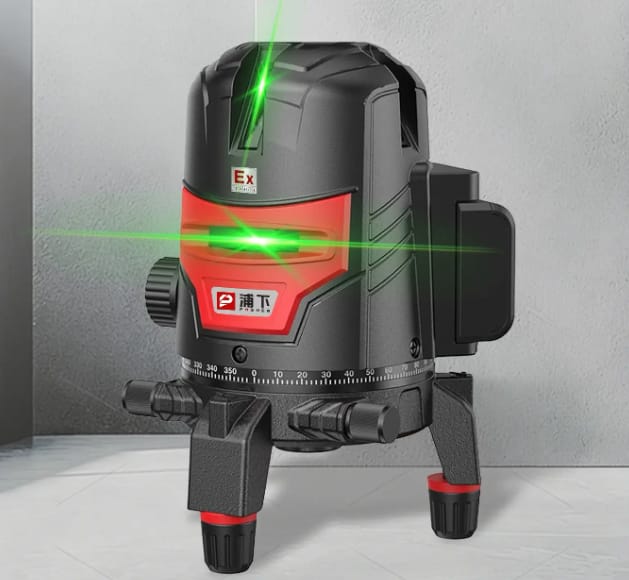
Laser levels are commonly used in machinery manufacturing—specifically in sheet metal processing plants and for marking/positioning on thick steel plates—as well as in various industrial production settings to assist with alignment and positioning. They are also widely used for equipment installation and in the construction industry for precise positioning. Given their versatility in our daily lives and work, here is a brief introduction to how to operate a laser level:
1. First, turn on the power switch (located on the side); this applies to both 3-line and 5-line models. The level features an automatic leveling system (indicated by a bubble vial; the bubble should be centered within the circle). If the surface is uneven, the device will emit an audible warning; the sound stops once the unit is level.
2. When taking measurements, ensure the base of the level is in firm contact with the surface being measured. Wait for the bubble to come to a complete standstill before taking a reading.
3. The level’s scale reading represents the inclination value based on a one-meter length. To calculate the actual inclination over a specific length (L), use the following formula:
Actual Inclination = Scale Reading × L × Number of Scale Divisions
4. To prevent data errors caused by an incorrect zero setting, the level’s zero position must be verified or adjusted before use.
Method for verifying and adjusting the zero position:
Place the level on a stable, roughly horizontal surface (such as a surface plate or machine tool guideway). Once the bubble stabilizes, take a reading at one end (e.g., the left side) and set it as zero. Then, rotate the level 180 degrees and place it back in the exact same spot. After the bubble stabilizes, take a reading at the same end (the left side) again; if the reading is “A” divisions, the zero-position error is A/2 divisions. If the zero-point deviation exceeds the permissible range, the level’s zero-adjustment mechanism (such as an adjustment screw or nut) must be adjusted to bring the deviation within limits. Do not arbitrarily turn screws or nuts that are not intended for adjustment. Before adjusting, ensure the working surface of the level and the reference plate are thoroughly cleaned; after adjustment, ensure all screws or nuts are securely tightened.
Have you ever seen workers handling these levels and thought they looked quite impressive? Yet, based on the explanation above, you might also feel that using a laser level is a bit of a complex task. I would like to remind everyone to strictly follow safety operating procedures when using a laser level; shining the beam into people’s eyes is strictly prohibited. Additionally, the laser tube inside the device is a sensitive component, so please pay attention to relevant safety precautions regarding electrical hazards and general protection.